
The continuing genocide in Gaza.
Israel’s illegal and unprovoked 12-day war against Iran.
The enthusiastic acceptance by Western powers of a wanted former al-Qaeda terrorist as Syria’s new leader.
The war of attrition in Ukraine grinds on despite the ultimate hopelessness of Ukraine’s situation.
The persistent fearmongering against China continues, unabated.
These and other events are generally reported, discussed and debated in isolation. But these events are not isolated. They are deeply interconnected.
The fate of the entire world is at stake. With the growing risk of conflict between nuclear armed powers, it is both urgent and necessary to frame what is occurring into a coherent narrative. A narrative that enables the understanding of current events. A desperate need as so many people struggle to comprehend the seemingly disparate conflicts and tragedies now occurring. A narrative that assists in critiquing Australia’s role in world affairs and can be used to argue alternate paths forward.
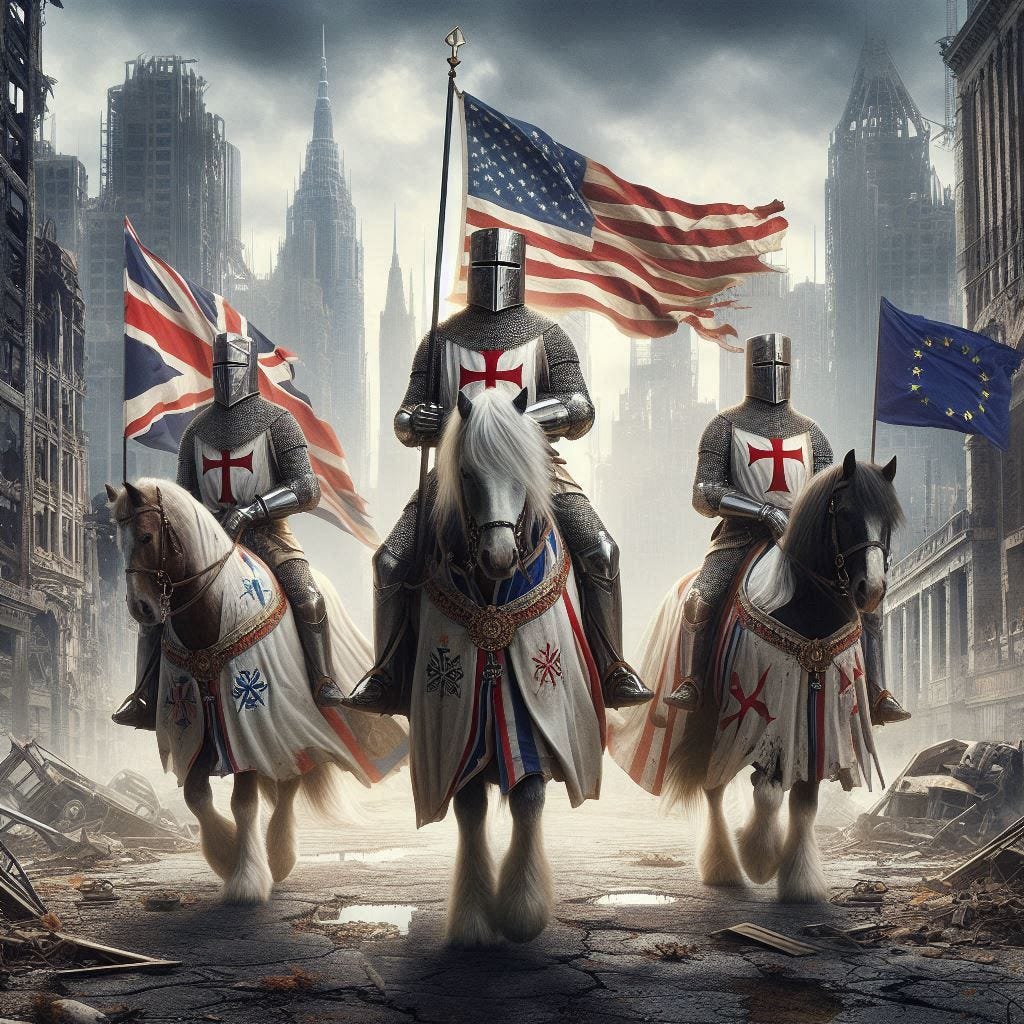
What I believe we are witnessing is the collective West’s pursuit of a ‘Crusade against Multipolarity.‘
The terms here are deliberately chosen for their explanatory value.
Multipolarity refers to the changing distribution of power in the global system, from the preceding unipolar moment dominated by the United States as the sole hegemonic power after the collapse of the Soviet Union, to the current system where multiple poles of power exist.
For most of the last 2000 years, if not longer, the eastern powers of China and India dominated the global economy. Western dominance of the global system is a relatively new phenomenon, barely a couple of centuries old. In 2018 the GDP (by Purchasing Power Parity) of the BRICS Plus nations surpassed that of the G7 with the gap between the two groups increasing year on year. What we are witnessing is a reversion to the historical mean, where Eurasia once again becomes economically dominant.
Ultimately power is a function of economic strength. The clear corollary here is that as the relative economic importance of the West continues to decline, so too will its power and influence. Columbia University’s Professor Adam Tooze somewhat dramatically describes this process as the ‘material dethroning of the West as the central driver of world history.’
To many in the political class across the collective West, this situation is intolerable. An affront to the belief in US exceptionalism and the superiority of the European ‘garden’ compared to the outside world’s ‘jungle’ as expressed by the former EU foreign policy chief Joseph Borrell. The response to this affront is the Crusade against Multipolarity.
Crusade is an appropriate description both from the perspective of its ordinary meaning as well as echoes back to the Crusades of the Middle Ages. The current Crusade seeks to restore US led Western dominance in the international system through means foul rather than fair, including the proxy wars, regime change, sanctions, lawfare and propaganda targeted directly or indirectly against key nodes in the multipolar world, and to domestic resistance. It is characterised by an ideological if not eschatological component which helps explain the unwavering commitment to a cause which is looking increasingly unrealistic if not hopeless.
Until relatively recently this Crusade was largely being played out under the detection threshold for most people due to the overwhelming dominance of legacy media’s control of the narrative. The abject failure of the United States and NATOs poorly thought through plan to ‘weaken Russia’ through the sacrifice of Ukraine, heralded a crucial turning point. For it is now abundantly clear to the majority of the world that the collective West is no longer dominant, lacking the economic power to collapse the Russian economy, the military power to defeat, nor the diplomatic power to isolate Russia.
Despite a growing list of failures (including Trump’s tariff tantrum, the attempt to overthrow the Iranian Government, the abject moral failure over the genocide in Gaza, and the defeat at the hands of the Houthis in the Red Sea), there has been no willingness amongst the leadership of the collective West, many of whom increasingly appear as zealots, to abandon this Crusade. There is, as The Duran’s Alexander Mercouris describes it, ‘no reverse gear.’
For a brief period after Russia’s invasion, the major protagonists in this Crusade, the United States and the European Union, coalesced. Now as growing failure becomes evident, the fractures in the collective West are becoming increasingly apparent. It is difficult at this point to determine who is playing whom. The recent apparently lopsided trade deal between the United States and Europe is a prime example. Is it really lopsided? Or has the European Union entrapped the United States in the European project for the foreseeable future as Professor Warwick Powell argues.
Yet despite these fractures, the Crusade carries on in both word and deed. The latest example being the United Kingdom’s Defence Secretary indicating that ‘Britain is ready to fight in the Pacific if conflict breaks out over Taiwan,’ despite as journalist Bryan McDonald highlights, the United Kingdom having more ‘military think tanks than warships.’
Australia, as a sub-imperial power, has and continues to be an active participant in this Crusade (examples abound including being a party to the proxy war against Russia, complicity to genocide, and supporting the illegal attack against Iran). Part of this is habitual through decades of subordinating our foreign policy to that of the United States. Increasingly it is performative. The banality of the mantras repeated by senior Minister’s such as ‘a peaceful, stable and prosperous Indo-Pacific’ being an example. As the international system continues to reorganise itself, Australia’s foreign policy is effectively rudderless. Stuck between an anachronistic past from which we cannot break free, and to timid to embrace a future which, given that geography is destiny, we could and should benefit mightily from.
There will be no happy ending for the Crusaders. Every passing week makes that clearer and clearer. The current frantic talk of a war with China over Taiwan, a logical future step after failing against Russia and Iran, should make that abundantly clear. For not only does Australia have little in the way of meaningful military power to embark on such a foolhardy expedition (other than the bases from which the United States could project military force) there is no positive outcome. Both an unlikely victory and a probable defeat will be catastrophic for Australia’s future.
Continued participation in this Crusade poses a fundamental question as to what is the purpose of the Australian Government and our political class? Is it to provide for the needs and desires of the Australian people? Or is it to participate, for the benefit of a small, largely international minority, in an increasingly cult like endeavour? From the vantage point of the citizens of Australia, it is unashamedly the former. Ending Australia’s participation in this Crusade would be a strong signal from our leadership that they too, are on our side!
An excellent and insightful piece, framing it as a crusade against multipolarity. Thanks for the shoutout too.